

 English
 中文简体
中文简体Aluminum Windows: The Ultimate Guide to Alloy and Hurricane-Resistant Options
Introduction Aluminum windows have become one of the most popular choices in modern construction, offering a balance of strength, style, and practical...
Read MoreMost window buyers compare price tags. Fewer compare what happens inside the frame — and that gap is exactly where the wrong decision gets made. If you're evaluating aluminium sliding windows against uPVC, the material grade and thermal barrier design will determine performance for the next several decades. Here's what the specification sheets actually mean in practice.
Content
Not all aluminium is the same. The 6063-T5 alloy is the architectural standard used in high-performance window profiles for a specific reason: it combines a minimum tensile strength of 241 MPa with a surface finish quality that accepts both anodizing and powder coating without defect. Lower-grade aluminium can be extruded into similar shapes, but the structural integrity under wind load and repeated operation cycles is categorically different.
A sliding window frame carries load differently than a fixed pane. Every time the sash moves, the track hardware, corner joints, and profile walls absorb force. In a 6063-T5 frame with 1.6–2.0mm wall thickness, that load is distributed predictably. Thinner profiles made from lower-specification alloys can flex over time, causing track misalignment and seal failure — problems that rarely appear in the first year but become expensive after five.
For residential and light commercial projects, our energy-efficient aluminium alloy sliding windows use 6063-T5 profiles with verified wind load resistance to Class 4 (3000Pa, EN 12210), which is the threshold for most regions with significant weather exposure.
Aluminium's weakness as a frame material is well established: it conducts heat roughly 1,000 times more efficiently than uPVC. Without intervention, a cold outdoor frame will chill the interior surface, creating condensation and driving up heating demand. Thermal break technology addresses this directly by physically separating the inner and outer aluminium sections with an insulating strip.
The barrier material matters. PA66 polyamide reinforced with glass fibre has a thermal conductivity of approximately 0.3 W/m·K — low enough to function as a genuine insulating bridge rather than simply slowing heat transfer. A 20mm polyamide barrier provides meaningful separation between the temperature zones, yielding a whole-window U-value of Uw = 1.1 W/m²K when combined with double-glazed Low-E units. That figure satisfies the thermal performance requirements for a wide range of climate zones and building standards.
Compare that to uPVC, which achieves good insulation through multi-chambered profiles that trap still air — an effective but passive approach. uPVC performs well in mild to moderate climates, but its operating temperature range is limited to roughly -10°C to 70°C. Outside those bounds, the material becomes brittle or soft. For regions with hard winters or intense summer heat, a thermally broken aluminium frame maintains dimensional stability that uPVC cannot match.
The 6063-T5 thermal break aluminium profile we supply is available in profile depths of 40–150mm with wall thickness ranging from 1.4 to 3.0mm, allowing engineers to specify exactly the structural and thermal performance the project requires.
The frame is the structural system. The glass is where energy loss is calculated. A sliding window with 5–24mm glazing options and a Low-E coating applied to the inner pane surface will reflect long-wave infrared radiation back into the heated space in winter, and reject solar heat gain in summer — without reducing visible light transmission significantly.
Standard double glazing (two panes separated by an air or argon-filled cavity) reduces U-values from around 5.8 W/m²K for single pane to roughly 2.8 W/m²K. Adding a Low-E coating brings that closer to 1.8–2.0 W/m²K. The combination of a 20mm thermally broken frame and Low-E double glazing consistently achieves the Uw = 1.1 W/m²K performance specification.
Triple glazing is available for projects in northern climates or passive house specifications, pushing whole-window U-values below 0.8 W/m²K. The trade-off is weight: a triple-glazed unit in a large sliding panel adds significant mass to the sash, requiring heavier-duty track hardware and rollers. This is why frame alloy grade and profile wall thickness matter — a lighter alloy profile under a heavy triple-glazed unit creates a long-term serviceability problem.
| Configuration | Whole-Window U-Value | Sound Reduction |
|---|---|---|
| Single pane, no thermal break | ~5.5 W/m²K | 18–22 dB |
| Double glazing, no thermal break | ~3.2 W/m²K | 25–30 dB |
| Double glazing + 20mm thermal break | ~1.8 W/m²K | 30–35 dB |
| Double glazing + Low-E + 20mm thermal break | ~1.1 W/m²K | 35–40 dB |
The structural strength difference between 6063-T5 aluminium and uPVC is substantial. Aluminium profiles in this grade carry roughly 30% higher structural capacity than uPVC equivalents at comparable wall thicknesses. In practical terms, this means aluminium can support larger single panel sizes — up to 1200×2400mm for a single-leaf sliding sash — without the section depth that uPVC requires for equivalent rigidity.
Larger glass areas mean more natural light and better views, which is the primary reason aluminium dominates commercial facades and is increasingly specified for high-end residential projects. A uPVC frame achieving the same span would require bulkier sections that reduce the glazed area and alter the proportions of the opening.
On lifespan, well-maintained thermally broken aluminium window systems consistently perform across 40–50 years. The frame does not rot, warp, or become brittle with age in the way that organic and plastic materials do. Powder-coated or anodized surfaces resist UV degradation, salt spray, and atmospheric pollutants without repainting. uPVC, by contrast, has an established replacement cycle of 25–30 years, after which the material surface tends to yellow and the chamber walls can develop micro-fractures that degrade sealing performance.
| Parameter | 6063-T5 Aluminium (Thermal Break) | uPVC |
|---|---|---|
| Structural strength | ≥241 MPa tensile strength | ~30–40 MPa (lower rigidity) |
| Expected lifespan | 40–50 years | 25–30 years |
| Operating temperature range | -40°C to 120°C (stable) | -10°C to 70°C (deformation risk) |
| Maximum single-leaf panel (typical) | 1200 × 2400mm | 900 × 1500mm (reinforced) |
| Recyclability | 100% indefinitely recyclable | Partial; chlorine content limits options |
Material choice carries environmental consequences that extend well beyond installation. Aluminium is one of the few construction materials that can be recycled indefinitely without loss of structural properties. The recycling process requires only around 5% of the energy needed to produce primary aluminium from bauxite, making recovered aluminium genuinely low-impact from a lifecycle perspective.
This matters to project certifications. Buildings pursuing LEED, BREEAM, or similar green building ratings receive credit for specifying materials with verified recyclable content and low-carbon end-of-life pathways. Aluminium window frames — particularly those using profiles with recycled content — align directly with these criteria. As research into aluminium profile sustainability confirms, the combination of long service life and full recyclability positions aluminium as one of the most resource-efficient choices available in the fenestration sector.
uPVC presents a more complex picture. While some manufacturers incorporate recycled material into profiles, the chlorine content of PVC creates complications in both the recycling stream and end-of-life disposal. For projects with sustainability certification targets, the documentation burden for uPVC can be higher — and the achieved credit score lower — than for aluminium.
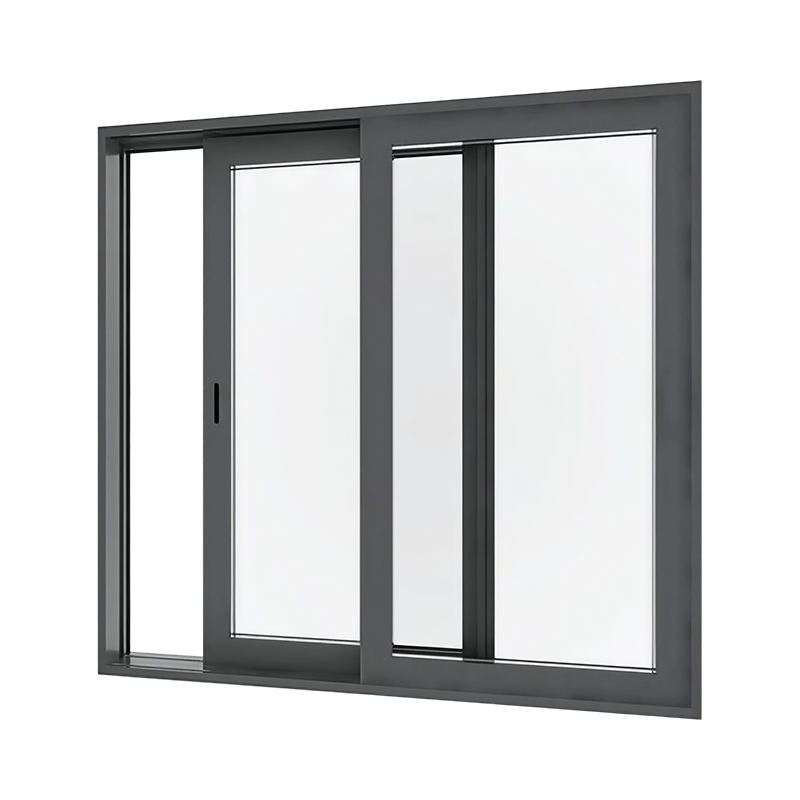
A high-specification window loses value quickly when installation quality is poor. For thermally broken aluminium sliding windows, the key parameters are the reveal depth and continuity of the thermal barrier through the installation interface.
A minimum reveal depth of 100mm is required to allow proper fixing, insulation packing, and sealing around the frame perimeter. Inadequate reveal depth forces the installer to compromise either the structural fixing or the insulation continuity — either outcome creates cold bridges or movement that degrades performance over time. Maximum single-leaf panel dimensions of 1200×2400mm should be treated as engineering limits, not targets. Practical panel sizing should account for building movement, glass unit weight, and hardware load ratings.
Standard finish options — silver anodized and white powder coating — cover the majority of residential applications. Anodizing provides a harder, more abrasion-resistant surface suited to high-traffic or commercial environments. Powder coating opens up a wider colour palette and is typically the choice for residential projects where the window colour is matched to the facade or interior scheme.
Our full range of aluminium alloy window systems covers sliding, casement, awning, and louvre configurations, all available with thermal break profiles and a range of glazing specifications to suit the project's climate zone and performance targets.
Specification sheets often list certifications without context. For sliding windows, three test standards are directly relevant to long-term performance.
These three certifications together define a window that performs reliably across the range of conditions it will encounter in service. A window meeting all three is not overspecified for residential use — it is appropriately specified for a component expected to perform for 40–50 years with only routine maintenance.
For project teams comparing window systems across suppliers, our complete guide to aluminium doors and windows for residential buildings covers specification criteria, installation requirements, and performance benchmarking in detail.
Thermally broken aluminium sliding windows are the right specification when three or more of the following conditions apply: the project requires panels larger than 900mm wide; the climate involves temperature extremes below -10°C or above 35°C; the building is pursuing a green certification; the specified lifespan exceeds 30 years; or the facade design requires slim sightlines and a contemporary profile.
uPVC remains a cost-effective choice for smaller-format windows in mild climates without certification requirements and where the 25–30 year replacement cycle is acceptable within the budget model. The decision is not about which material is universally better — it's about which material is correctly matched to the project's requirements.
For projects where the specification calls for verified thermal performance, structural integrity under large-panel loads, and a documented sustainability pathway, 6063-T5 thermally broken aluminium with Low-E double glazing is the specification that delivers on all three without trade-offs. Contact our technical team to discuss your project parameters and receive a detailed specification recommendation.


