

 English
 中文简体
中文简体Aluminum Windows: The Ultimate Guide to Alloy and Hurricane-Resistant Options
Introduction Aluminum windows have become one of the most popular choices in modern construction, offering a balance of strength, style, and practical...
Read MoreResidential construction trends over the past decade point in one direction: aluminum has quietly displaced wood, steel, and uPVC as the frame material of choice for doors and windows across a wide range of building types — from single-family homes to mid-rise apartment blocks. The reasons are practical rather than fashionable. Aluminum offers a strength-to-weight ratio that allows slimmer profiles and larger glass panes, it does not rot, warp, or rust, and modern surface treatments mean a well-specified aluminum frame will look the same in twenty years as it does on installation day.
This guide covers everything a homeowner, developer, or architect needs to know before specifying aluminum doors and windows for a residential project — from the right product type for each opening to thermal performance figures, surface finish selection, and the quality checks that distinguish a long-lasting installation from one that starts causing problems within a few years.
Content
Wood frames require repainting every five to seven years and are vulnerable to moisture in bathrooms, kitchens, and coastal environments. Steel is structurally superior but heavy, expensive to fabricate, and prone to corrosion without diligent maintenance. uPVC offers good thermal performance at low cost, but its relatively bulky profiles limit the glazing area and its colour palette is restricted — once faded or cracked, the frame cannot be refinished.
Aluminum sidesteps most of these constraints. The material is roughly one-third the weight of steel, allowing large door and window units to be handled and installed without heavy equipment. Its natural oxide layer provides baseline corrosion resistance; with an additional powder coat or anodised finish, it becomes effectively maintenance-free in most climates. Profile walls as thin as 1.4 mm can carry significant loads, which is why modern aluminum systems can achieve floor-to-ceiling glazed walls that would be structurally impossible with wood or uPVC.
The design flexibility is equally significant. Aluminum extrusions can be produced in virtually any cross-section profile, and the material accepts powder coating in hundreds of RAL colours as well as wood-grain transfer finishes. A single material system can serve a contemporary home with black-frame glazed walls, a coastal villa with marine-grade anodised frames, and a heritage renovation with bronze powder-coat profiles — all using the same underlying alloy and manufacturing process.
The right product type depends on the opening's size, the direction it faces, how the space is used, and how much ventilation control is needed. Mixing types within a single project is common and often the right approach.
The single most important technical decision in specifying aluminum doors and windows for a residence is whether to use standard or thermal break profiles. The difference in energy performance is not marginal.
Standard aluminum is a conductor. A continuous aluminum frame transfers heat from the warm side to the cold side of the wall almost as efficiently as a solid metal bar. In practice, this means condensation on interior frame surfaces in winter, uncomfortable cold radiation near windows, and measurable heat loss that drives up heating costs. A standard aluminum window can have a U-value (thermal transmittance) of 4.0–6.0 W/m²K — comparable to single-pane glass.
Thermal break profiles solve this by inserting a polyamide strip between the outer and inner sections of the aluminum extrusion, interrupting the conductive pathway through the frame. Engineering analysis of modern thermal break systems shows whole-window U-values routinely achieved between 0.8 and 2.0 W/m²K — a 70–85% improvement over standard profiles. When paired with double-glazed low-E units filled with argon gas, a thermal break window can meet the energy codes of most temperate and cold climates without any additional insulation measures at the frame.
The 6063-T5 thermal break aluminum alloy profiles used in quality residential systems balance structural strength with the wall thickness needed to accommodate a wide polyamide break. Wider breaks (28–36 mm) consistently outperform narrower ones (14–20 mm) in cold climates; in mild or warm climates, a narrower break combined with a high-performance glazing unit is usually sufficient.
| Profile Type | Glazing | Approximate Uw (W/m²K) | Typical Application |
|---|---|---|---|
| Standard aluminum (no break) | Single pane | 5.0–6.5 | Not recommended for heated residential spaces |
| Thermal break (20 mm) | Double glazing, air-filled | 2.4–2.8 | Mild climates, budget-conscious projects |
| Thermal break (28–32 mm) | Double low-E, argon-filled | 1.4–1.8 | Temperate climates, standard residential |
| Thermal break (36 mm+) | Triple low-E, argon-filled | 0.9–1.2 | Cold climates, high-performance residential |
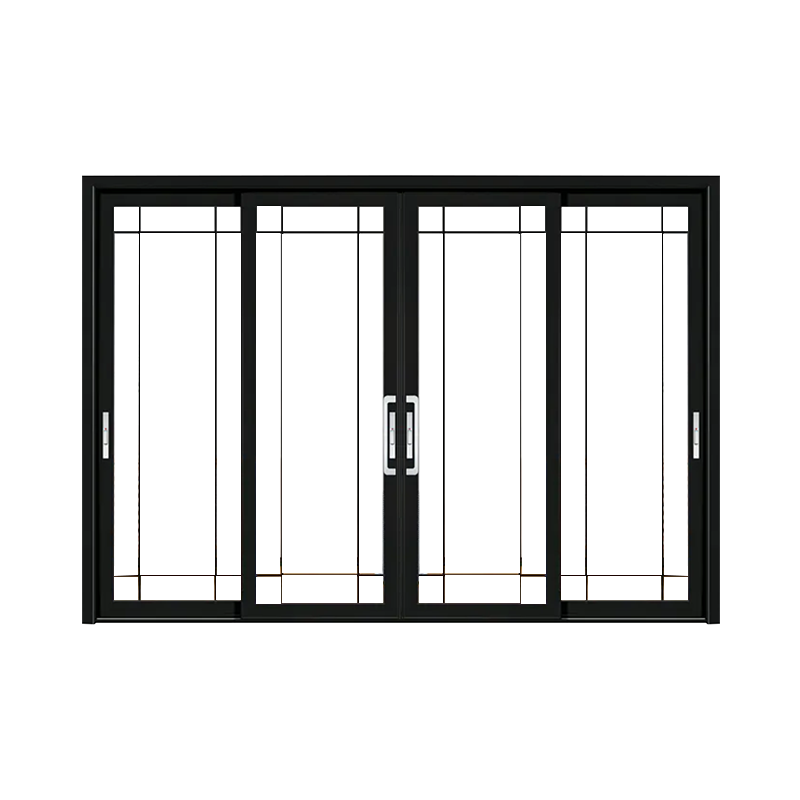
Aluminum's base corrosion resistance is good but not uniform across all environments. The alloy composition, the surface treatment, and the installation detail around the frame perimeter all affect how the product ages. Getting this right at the specification stage is far easier than dealing with finish degradation or frame corrosion five years after installation.
The most widely used alloy for residential door and window profiles is 6063-T5, which offers a good balance of extrudability, surface quality, and structural strength. In coastal environments within approximately two kilometres of breaking surf, a 6063-T6 alloy with a marine-grade anodised finish (minimum 25 microns) or a PVDF fluorocarbon coating is advisable. Standard powder coatings (AAMA 2603 or equivalent) perform well in inland and suburban environments but can chalk over time in high UV-exposure locations; upgrading to a super-durable polyester or PVDF coat (AAMA 2604 or 2605) significantly extends the finish life.
The four main surface treatment options each suit different project types:
A well-made aluminum door or window is only as good as its weakest component — and in residential applications, that weak point is usually the hardware. Hinges, rollers, locking mechanisms, and handles all operate under repeated cyclical load, and cheap hardware fails long before the frame or glass.
For windows, multi-point locking handles that engage at two or more points on the perimeter sash are significantly more secure and provide better compression against the seal than single-point handles. For sliding and folding doors, stainless steel or marine-grade zinc alloy rollers are worth specifying over standard zinc; the cost difference is small relative to the improvement in longevity and smooth operation.
Glass specification matters equally. For any ground-floor door or large window, laminated safety glass (a PVB interlayer between two panes) is strongly preferable to toughened glass alone. Laminated glass holds together on impact rather than shattering, which improves both security and injury risk. Where thermal performance is also a priority, a laminated low-E unit combines both benefits in a single glazed assembly.
Before confirming an order, verify the following against the product specification sheet:
Reviewing the full range of aluminum alloy windows alongside door options allows the project specification to be coordinated as a system — matching profile series, surface finish, glazing specification, and hardware across all openings produces a consistent result and simplifies the supply chain for both new builds and renovation projects.


