

 English
 中文简体
中文简体Aluminum Windows: The Ultimate Guide to Alloy and Hurricane-Resistant Options
Introduction Aluminum windows have become one of the most popular choices in modern construction, offering a balance of strength, style, and practical...
Read MoreContent
A prefabricated curtain wall is a building envelope system where the aluminum framing, glass or infill panels, gaskets, insulation, and often the interior finish are assembled into complete, watertight units inside a controlled factory environment, then transported to the construction site and lifted directly onto the building structure. This approach—commonly called unitized curtain wall—stands in contrast to stick-built systems, where the aluminum mullions are erected first on the building face and the glass is installed afterward, piece by piece, from exterior scaffolding or swing stages. The factory-assembled unit typically spans one floor height by one structural bay width, measuring 3.0 to 4.5 meters tall and 1.2 to 2.0 meters wide, and arrives on site with its vision glass, spandrel glass, thermal breaks, vapor barriers, and interlocking perimeter frame already integrated. The primary advantage is not merely speed—though a unitized system can enclose a floor in days rather than weeks—but quality control. The factory applies consistent sealant joint geometry, gasket compression, and dimensional tolerance under conditions that no exposed building edge can match. The primary constraint is that the entire logistics chain, from factory dimensional control to site cranage sequencing, must be planned and coordinated before the first unit leaves the production line.
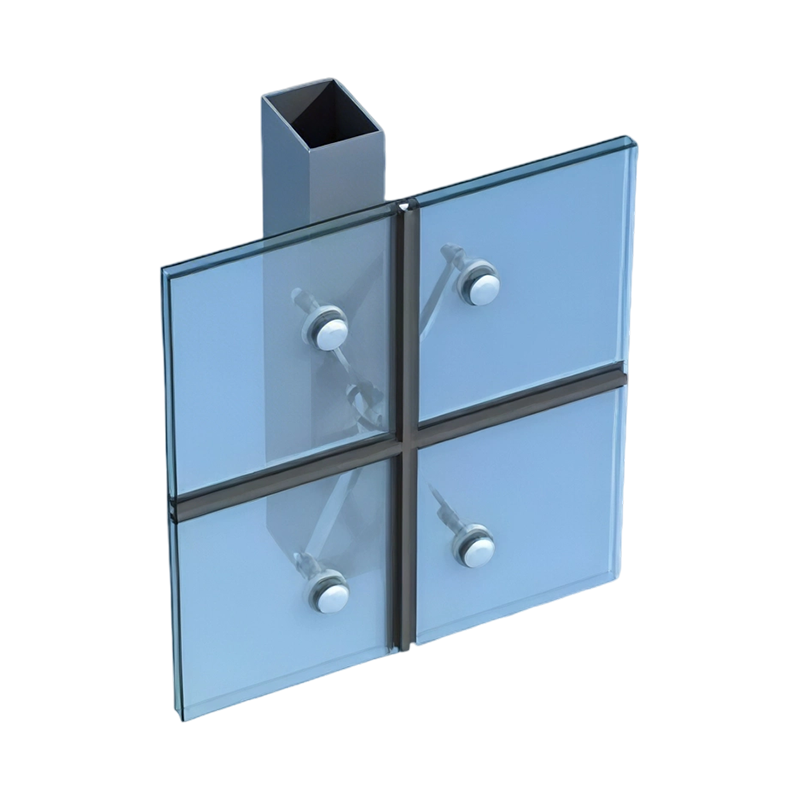
The choice between a unitized prefabricated curtain wall and a conventional stick-built system is not a matter of preference—it is a structural, logistical, and economic decision that must be made early in the design phase. Stick-built systems ship aluminum extrusions in linear lengths to the site, where they are cut, machined, and assembled into a grid. This approach offers lower initial material cost and greater dimensional flexibility to accommodate as-built structural variations, but it transfers the quality burden to the site workforce and exposes sealant application to wind, dust, and temperature extremes. Unitized systems concentrate labor in the factory, where automated CNC machining ensures frame squareness within 1 millimeter across the diagonal, and where two-part structural silicone can cure under controlled temperature and humidity. The trade-off is that unitized systems demand far tighter structural tolerance from the primary building frame—typically ±10 millimeters in slab edge position and ±5 millimeters in floor-to-floor height—because the prefabricated units are dimensionally fixed and cannot be field-modified to accommodate unexpected deviations. A building with cast-in-place concrete slabs that vary by 25 millimeters from floor to floor will require extensive shimming and bracketry to accept unitized panels, potentially erasing the speed advantage that justified the prefabricated approach.
The vertical and horizontal joints between adjacent unitized panels are the defining technical feature of a prefabricated curtain wall, and they operate on a principle that is frequently misunderstood. The joint is not a sealed, waterproof barrier. It is a pressure-equalized rain screen cavity designed to admit a controlled amount of air while preventing water penetration through a combination of labyrinth geometry, staged drainage, and compartmentalization. The outer face of the joint has an open or baffled gap that allows exterior air pressure to communicate into a chamber behind the outer gasket. Because the pressure in this chamber equalizes with the exterior wind pressure, there is no pressure differential to drive rainwater across the outer seal and into the building. Any water that does enter the outer chamber—from wind-driven rain or surface tension creep—hits a secondary inner seal that forms the air barrier, and gravity drains the water down through vertical channels within the joint to horizontal joints, where it is expelled to the exterior at each floor level. The joint must be compartmentalized at every floor line and at every mullion intersection to prevent the chimney effect, where a pressure differential between different elevations on the building face drives air vertically through an unsealed joint and carries water with it. The compartment seals—typically EPDM or silicone gaskets installed at the factory—are the most critical and most frequently overlooked component of the joint system.
A properly engineered interlocking joint contains three distinct gasket stages. The outer rain gasket is a ventilated EPDM profile that blocks direct rain entry while allowing air passage. The middle pressure equalization gasket divides the joint cavity into outer and inner zones and incorporates precisely sized vent slots that control the rate of pressure equalization. The inner air seal gasket, typically a continuous silicone extrusion, forms the primary air barrier and must maintain a compression set below 20% after 1,000 hours at 100 degrees Celsius to ensure it remains elastic over the building's service life. In a factory-assembled unitized system, the horizontal joint gaskets are pre-compressed during unit assembly and the vertical joint gaskets are pre-installed on the unit frame, so that when two adjacent units are mated on site, the gaskets engage with their design compression without requiring the installer to adjust or position them—a critical advantage over stick-built systems where gasket installation is a field operation subject to installer variability.
A prefabricated curtain wall must manage the thermal bridge that the aluminum frame creates between the exterior and interior environments. The aluminum mullions and transoms, if left as solid extrusions, would conduct heat through the building envelope at a rate that makes energy code compliance impossible. The solution is a structural thermal break—a pair of low-conductivity polymer struts, typically extruded polyamide 6.6 reinforced with 25% glass fiber, that are mechanically crimped into a continuous aluminum extrusion to create separate interior and exterior aluminum profiles connected only by the polymer isolators. The polyamide struts reduce the frame's U-factor from approximately 6.0 W/m²K for a non-thermally-broken aluminum section to as low as 1.8 W/m²K for a high-performance thermally broken section. In a unitized system, the thermal break is integrated into the factory-assembled frame, and the thermal performance of the entire assembly—including the joint—is tested at an accredited laboratory to a standard such as AAMA 501 or EN 13830. The joint itself is a thermal weak point because the interlocking frame members create a path for heat to bypass the thermal break, and high-performance unitized systems address this with insulating foam inserts within the joint cavity and with thermally broken pressure plates that maintain the insulation plane across the unit-to-unit junction.
Each unitized panel in a prefabricated curtain wall is individually supported by the building structure, typically through a pair of adjustable brackets anchored to the slab edge. The dead load of the unit—which for a fully glazed panel 1.5 meters wide by 3.6 meters tall can exceed 250 kilograms—is transferred through the vertical mullions of the unit frame to the brackets at the floor level. One bracket is designed as a fixed bearing, accepting both vertical and horizontal loads; the other is a sliding bearing that accepts vertical loads but allows horizontal movement to accommodate thermal expansion and live load deflection of the slab. The brackets incorporate three-axis adjustability—vertical via a slotted hole or leveling bolt, lateral via a slotted base, and in-out via a threaded stud or serrated washer—to align the unit to the building datum despite the slab edge tolerance accumulation. The anchor embedment into the concrete slab is typically a cast-in channel or a post-installed undercut anchor, and the anchor specification must account for the eccentricity of the curtain wall dead load applied at the slab edge, which imposes a pull-out force on the anchors in addition to the shear force from the panel weight. A miscalculation at this interface—either in the anchor design or in the bracket adjustment range—is the most common cause of unitized curtain wall installation delays and the most expensive to rectify after panels have been lifted into position.
The dimensional relationship between the prefabricated curtain wall and the building structure is managed through a survey-and-design process that must be completed before factory production begins. The building structure is surveyed at each floor level using total station equipment to establish the as-built slab edge position in all three axes, and this data is compared to the design model to determine whether the panel dimensions can remain as designed or must be adjusted to accommodate deviations. In a typical project, the curtain wall contractor will embed the brackets and adjusters within a tolerance band that the prefabricated units can absorb—usually ±15 millimeters for in-out adjustment and ±25 millimeters for lateral adjustment. If the as-built structure exceeds these limits, the options are to modify the bracket system, which is relatively inexpensive, or to modify the unit dimensions, which is costly and schedule-disruptive because it breaks the production batch uniformity that is the economic foundation of prefabrication. The dimensional control process therefore includes a pre-production survey, a bracket installation survey, and a post-installation verification survey, with the results of each stage informing the next. A project that skips the pre-production survey and proceeds directly from design dimensions to factory production accepts a significant risk of field fit problems that cannot be economically resolved on site.
The glazing infill in a prefabricated curtain wall can be installed in the factory as part of the unit assembly or left for field installation after the frames are erected. Factory glazing is the predominant approach for unitized systems because it places the structural silicone glazing sealant application in a controlled environment where temperature, humidity, and surface cleanliness can be guaranteed. The two-part structural silicone that bonds the glass to the aluminum frame requires a minimum application temperature of 10 degrees Celsius and a maximum relative humidity of 75% for proper curing, conditions that are reliably met in a factory but frequently violated on an exposed building edge. Factory glazing also eliminates the need for exterior access equipment to handle large glass units at height. The infill types follow the same range as stick-built curtain walls: monolithic or insulating glass units in clear, tinted, low-E, or fritted configurations, plus opaque spandrel panels of aluminum composite material, insulated metal panel, or glass with a ceramic frit back-painted finish. The spandrel zone behind the opaque panel must include insulation and a vapor barrier integrated into the unit frame, and in a factory-assembled unit this entire build-up is completed under quality-controlled conditions before the unit is crated and shipped.
| Criterion | Unitized Prefabricated | Stick-Built |
|---|---|---|
| Primary assembly location | Factory floor | Building exterior at height |
| Quality control environment | Controlled temperature, humidity, clean surfaces | Weather-dependent, variable conditions |
| Structural tolerance required | Tight: ±10 mm slab position typical | Flexible: accommodates larger deviations |
| Enclosure speed per floor | 2–5 days once crane cycle established | 1–3 weeks depending on access method |
| Site labor requirement | Low: crane operator, installation crew of 4–6 | High: multiple trades, scaffold or swing stage |
A prefabricated curtain wall introduces a logistics constraint that stick-built construction does not face: the panels are large, heavy, fragile, and must arrive on site in a sequence that matches the installation order. A single unitized panel in its protective crate occupies approximately 5 to 7 cubic meters of shipping volume and weighs 200 to 400 kilograms. A project requiring 800 panels cannot store all of them on site simultaneously; it must receive them in batches coordinated with the installation schedule. The panels are shipped from the factory in the reverse order of installation—the top-floor panels are loaded last so they are first off the truck—and each panel is marked with its unique identification code corresponding to its position on the building grid. A panel delivered out of sequence, or a panel damaged in transit that requires a replacement from the factory, can stop the installation crew's progress because the interlocking joint geometry means that panels must be installed sequentially along the floor. The logistics planning therefore includes a buffer stock of critical components at the factory, a quality inspection at both the factory exit and the site receipt point, and a crane schedule that dedicates specific hours of the day to curtain wall installation so that the crane is not shared with structural steel or mechanical equipment during the panel lift window.
Before a prefabricated curtain wall enters full production, a representative section—typically two full units wide by two units tall, incorporating a floor line joint—is assembled and subjected to a battery of performance tests at an accredited laboratory. The test sequence follows ASTM E283 for air infiltration, ASTM E331 for water penetration under static pressure, and AAMA 501.1 for dynamic water penetration under simulated wind-driven rain conditions generated by an aircraft engine propeller. The mock-up is then subjected to structural load tests that apply positive and negative wind loads to 150% of the design pressure, during which the frame deflection is measured and must not exceed L/175 of the span for aluminum members. Finally, an interstory drift test simulates the horizontal displacement that occurs during a seismic event, typically ±25 millimeters for a mid-rise building, and the curtain wall must accommodate this movement without glass-to-frame contact and without permanent deformation that compromises the weather seals. The performance mock-up is not a formality—it is the contractual verification that the specific frame profile, gasket configuration, glass type, and assembly procedures that will be used in production actually meet the specified performance criteria. Changes to any of these elements after mock-up approval require either re-testing or an engineering analysis that demonstrates equivalent performance.
The inter-panel joint in a prefabricated curtain wall must function as a movement joint that accommodates building sway without transferring stress to the glass or breaching the weather seals. The joint width at rest is typically 15 to 20 millimeters, and the gasket geometry allows this width to open or close by ±5 to ±8 millimeters while maintaining weather seal compression and air barrier continuity. In high-seismic zones, the required movement capacity increases, and the joint design may incorporate a deeper male-to-female interlock engagement to prevent disengagement during a large lateral displacement. The seismic movement is accommodated at the panel connections through slotted brackets that allow the panel to slide relative to the structure, so that the interstory drift is distributed across multiple panel joints rather than being concentrated at a single floor line. The panels themselves are laterally supported at each floor level to prevent racking, and the structural silicone glazing sealant is formulated with a movement capability of ±25% to ±50% of the joint width to accommodate the shear displacement between the glass and the aluminum frame without cohesive failure of the sealant.


