

 English
 中文简体
中文简体Aluminum Windows: The Ultimate Guide to Alloy and Hurricane-Resistant Options
Introduction Aluminum windows have become one of the most popular choices in modern construction, offering a balance of strength, style, and practical...
Read MoreContent
Aluminum has become the dominant framing material for both folding and sliding door systems in residential and commercial construction, and the reasons go well beyond aesthetics. At its core, aluminum offers an exceptional strength-to-weight ratio — it is rigid enough to support large glass panels spanning several meters without warping or bowing, yet light enough that panels can be moved effortlessly by a single person. Unlike timber, aluminum does not swell, shrink, rot, or warp in response to moisture and temperature changes, which is particularly important for doors that form the boundary between conditioned interior spaces and exterior weather conditions. Unlike steel, aluminum is naturally corrosion-resistant due to its self-forming oxide layer, making it suitable for coastal environments and high-humidity climates without requiring paint systems or galvanic protection.
From a manufacturing standpoint, aluminum extrusion technology allows profile designers to create highly complex cross-sections that integrate thermal break cavities, glazing rebates, hardware channels, drainage pathways, and weather seal grooves into a single precision component. This design flexibility enables aluminum folding doors and aluminum sliding doors to achieve performance levels — in terms of air infiltration, water resistance, acoustic attenuation, and thermal insulation — that would be impossible to match using traditional materials at a comparable cost. The combination of durability, low maintenance, design flexibility, and performance makes aluminum the material against which all other door framing systems are measured.
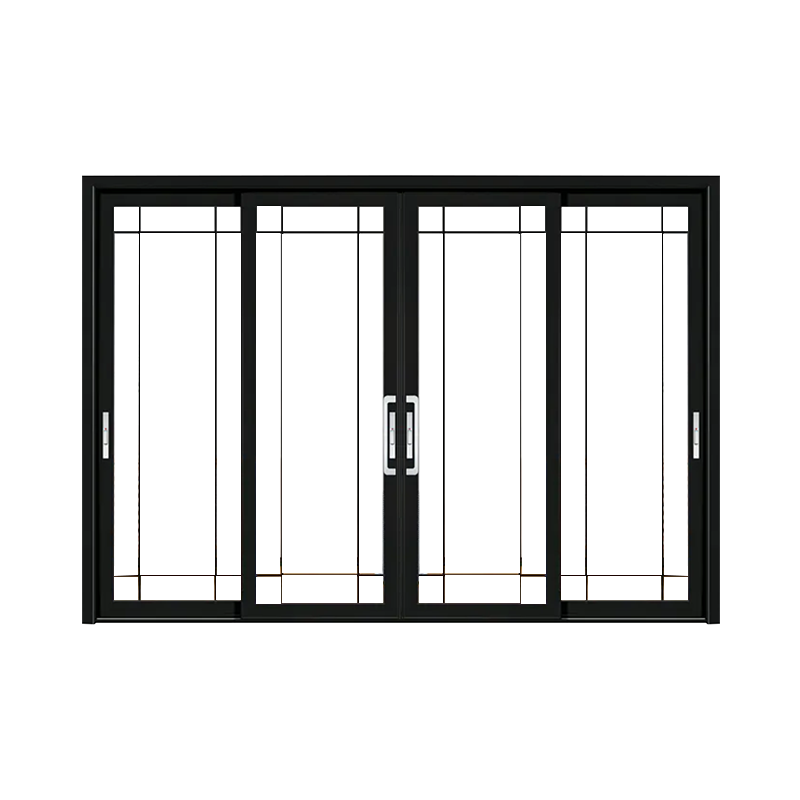
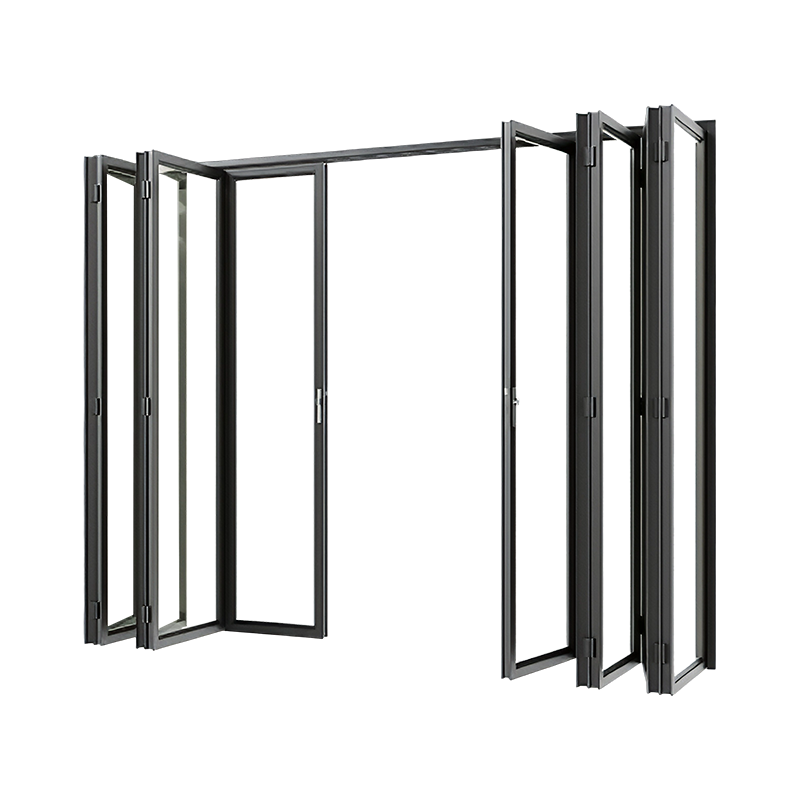
Aluminum folding doors — also referred to as bifold doors or accordion doors — operate on a system of hinged panels that fold sequentially against each other as the door opens, guided by a track at the top, bottom, or both. Each panel is connected to its neighbor by a vertical hinge, and the entire assembly collapses into a compact stack at one or both ends of the opening. This stacking action means that when fully open, an aluminum folding door system can expose virtually the entire width of the opening — typically leaving only 10–15% of the opening width occupied by the folded stack. No other door type achieves this level of open-to-view ratio, which is why folding doors have become the signature feature of indoor-outdoor living spaces, resort hospitality projects, and contemporary open-plan homes.
Aluminum folding door systems can be configured in a wide range of panel arrangements to suit different opening widths, traffic patterns, and stacking preferences. The most common configurations are described by the number of panels and the direction in which they stack. A 3-panel system folding to the left (3L) is common for openings of 2.4m to 3.6m, while larger openings of 4.8m to 9m or more typically use 4, 5, 6, or even more panels. Systems can stack entirely to one side (single stack), which maximizes the clear opening on one side but requires wall space for the folded panels, or split in the middle (center fold or double stack), which distributes the panel stack on both sides and creates a wider central opening with balanced aesthetics. A traffic door — one panel within the system that can be opened independently like a conventional hinged door — can be incorporated into any configuration, allowing everyday access without opening the entire system.
The structural support method for aluminum folding door panels is one of the most consequential specification decisions. Top-hung systems suspend all panel weight from a structural header track above the opening, leaving the floor track as a guide-only component with minimal load. This approach allows for slimmer, less obtrusive bottom tracks — some as shallow as 15–20mm — that present minimal trip hazard and are easier to clean. Top-hung systems do require a structurally adequate lintel or beam above the opening to carry the full panel load, which must be calculated based on the total number and size of panels. Bottom-rolling systems carry the panel weight through rollers running in a substantial floor-level track, reducing the structural demand on the header but requiring a more prominent bottom track that can accumulate debris and present a greater threshold step. For most contemporary residential applications, top-hung systems are strongly preferred for their cleaner appearance and better drainage management.
Aluminum conducts heat approximately 1,000 times more readily than timber and 200 times more readily than PVC, which means that without deliberate thermal engineering, an aluminum folding door frame becomes a significant thermal bridge between the warm interior and cold exterior. Modern thermally broken aluminum folding door profiles address this by incorporating a continuous polyamide (nylon) bar — or in high-performance systems, a poured and debridged polyurethane core — running through the center of each profile, separating the interior aluminum face from the exterior aluminum face. This thermal break reduces the frame's thermal conductivity dramatically, and when combined with double or triple glazing using low-emissivity coatings and argon or krypton gas fills, thermally broken aluminum folding doors can achieve whole-door U-values competitive with high-quality timber or PVC systems. For energy-conscious projects or buildings subject to strict building energy codes, specifying thermally broken profiles is not optional — it is a fundamental performance requirement.
Aluminum sliding doors operate on a fundamentally different principle from folding systems: rather than folding and stacking, each panel glides horizontally along a track system, with panels either stacking behind each other in a pocket or against a fixed adjacent panel. The key advantage of sliding over folding is that each panel retains its full structural integrity at all times — there are no hinge points under load, and the panel geometry is never distorted during operation. This makes aluminum sliding doors the preferred choice for very large, very heavy panel configurations where the structural integrity of each panel must be maintained precisely to ensure consistent weather sealing and smooth hardware operation.
The most significant technical distinction within aluminum sliding door systems is between conventional sliding doors and lift-and-slide door systems. In a conventional sliding door, the panel rollers run continuously in the track, meaning the weather seal between the panel and the frame is under constant compression regardless of whether the door is open or closed. In a lift-and-slide system, the operating handle actuates a multipoint locking mechanism that simultaneously lifts the panel slightly off the track seals when opening and lowers it firmly back down onto the seals when closing and locking. This compression-sealing action — identical in principle to that used in high-performance tilt-and-turn windows — creates a much more airtight and watertight seal than a conventional sliding door can achieve, while also reducing the effort required to slide the panel since it is lifted clear of the seals during movement. Lift-and-slide aluminum sliding doors can accommodate panel weights exceeding 500 kg per leaf, making truly massive floor-to-ceiling glass panels feasible.
Single-track aluminum sliding door systems — where one panel slides behind a fixed adjacent panel — are limited in how much of the total opening width they can expose, typically 50% for a two-panel system. Multi-track configurations overcome this limitation by running panels on separate parallel tracks at different depths, allowing all panels to be slid to one side and stacked without occupying the same track position. A three-track system with three panels, for example, can expose approximately 67% of the total opening width when all panels are stacked. Four-track systems with four panels can expose 75% of the opening. Some specialist aluminum sliding door systems use a pocket configuration, in which the sliding panels retract into a cavity within the adjacent wall structure, achieving close to 100% clear opening — a detail used in high-end hospitality and residential projects where the boundary between interior and exterior is meant to disappear entirely.
The roller and track hardware in an aluminum sliding door system must be specified according to the panel weight, frequency of operation, and required service life. Stainless steel rollers with sealed ball bearings are standard for quality systems and should be rated for the actual panel weight with a safety factor of at least 3:1. Track profiles must be deep enough and precisely manufactured to keep rollers engaged under lateral wind loads — in exposed locations, wind loading on a large glass panel can impose significant horizontal forces on the track system. Anti-jump devices, which prevent panels from being accidentally lifted clear of the bottom track in high-wind conditions, are essential for any exterior aluminum sliding door application. For commercial or high-traffic applications, specifying heavy-duty hardware with a published cycle life — typically 100,000 to 500,000 open-close cycles for quality commercial hardware — provides assurance of long-term performance.
Choosing between aluminum folding doors and aluminum sliding doors for a specific application requires an honest assessment of the priorities of the project — clear opening width, weather performance, panel size, operational simplicity, aesthetic character, and budget all play a role. Neither system is universally superior; each has genuine advantages in specific contexts. The table below summarizes the key comparative factors to guide specification decisions.
| Factor | Aluminum Folding Doors | Aluminum Sliding Doors |
| Maximum clear opening | 85–90% of total width | 50–100% (pocket configuration) |
| Individual panel weight | Typically up to 100 kg per panel | Up to 500+ kg per panel (lift-and-slide) |
| Weather sealing performance | Good; limited by hinge joint seals | Excellent (lift-and-slide compression seal) |
| Ease of operation | Moderate; multiple panels to move | Very easy; single panel glides smoothly |
| Floor space required | Panels fold inward or outward; interior space needed | Panels stack laterally; wall space needed |
| Acoustic performance | Limited by hinge joint gaps | Superior with lift-and-slide compression |
| Typical application | Residential indoor-outdoor living areas | Large residential and commercial glazed facades |
| Relative cost | Moderate | Moderate to high (lift-and-slide premium) |
The glass panels in aluminum folding doors and aluminum sliding doors typically account for 80–90% of the total door face area, which means glazing specification has a far greater impact on overall thermal, acoustic, and solar performance than the aluminum frame itself. For most applications in temperate or cold climates, double glazing with a warm-edge spacer bar, low-emissivity (low-E) coating on the inner glass surface, and an argon gas fill is the minimum acceptable specification. This combination reduces heat loss through the glass to a center-pane U-value of approximately 1.0–1.2 W/m²K, compared to 5.8 W/m²K for single glazing. Triple glazing, using three panes of glass with two gas-filled cavities, reduces center-pane U-values to 0.5–0.7 W/m²K and is increasingly specified in passive house and near-zero-energy building projects.
Solar control coatings — which selectively reflect or absorb solar infrared radiation while maintaining high visible light transmission — are essential for south, west, or unshaded east-facing glazed openings where summer overheating is a risk. A solar heat gain coefficient (SHGC) of 0.25–0.35 is appropriate for high solar exposure applications, while a higher SHGC of 0.45–0.60 may be preferred for north-facing or shaded openings where passive solar gain in winter is beneficial. Acoustic laminated glass — in which a polyvinyl butyral (PVB) interlayer bonds two glass plies together — significantly improves sound insulation performance compared to standard float glass of the same thickness, and is recommended for doors facing roads, rail lines, or other noise sources. Safety laminated or toughened glass is mandatory in most jurisdictions for any glazing within 800mm of floor level, which applies to virtually all floor-to-ceiling sliding and folding door panels.
One of the most compelling advantages of aluminum as a door framing material is the exceptional range and durability of available surface finishes. The two primary finishing methods are powder coating and anodizing, each with distinct characteristics that suit different project requirements and aesthetic preferences.
Powder coating applies a dry thermosetting polymer powder electrostatically to the aluminum profile surface, which is then cured in an oven to create a hard, continuous film. The range of available colors is essentially unlimited — any RAL, NCS, or custom color can be matched — and texture options include smooth, satin, matt, gloss, and textured finishes. For exterior applications in demanding environments, polyester powder coatings applied to pre-treated (chrome-free or chrome-based conversion coated) aluminum to Qualicoat Class 1 or Class 2 standards provide a service life of 15–25 years before significant fading or chalking. Dual-color systems — where the interior face of the profile is coated in a different color from the exterior face — allow the door to complement different interior and exterior design palettes simultaneously, a popular option for homes with white or timber-look interiors paired with dark exterior color schemes.
Anodizing is an electrochemical process that thickens and hardens the natural aluminum oxide layer on the profile surface, creating an integral finish that is part of the aluminum itself rather than a coating applied on top. Anodized finishes are available in natural silver, champagne, light bronze, medium bronze, dark bronze, and black, as well as a range of wood-effect and bespoke colors through specialized processes. The primary advantage of anodizing is its exceptional hardness (the anodized layer is harder than stainless steel) and its resistance to abrasion, which makes it ideal for high-traffic commercial applications or door systems in coastal environments where airborne salt particles can abrade softer coatings. Anodizing to Qualanod Class 20 (20-micron oxide layer) is the standard for architectural exterior applications and provides a service life exceeding 30 years in most environments.
Both aluminum folding doors and aluminum sliding doors are precision-engineered systems that require careful preparation of the structural opening, accurate installation, and correct weatherproofing to perform as designed. Inadequate structural support, incorrect threshold detailing, or poor sealing at the perimeter will undermine even the highest-specification door system. The following points cover the most critical installation and specification requirements that architects, builders, and specifiers should confirm before ordering or installing either system.


