

 English
 中文简体
中文简体Aluminum Windows: The Ultimate Guide to Alloy and Hurricane-Resistant Options
Introduction Aluminum windows have become one of the most popular choices in modern construction, offering a balance of strength, style, and practical...
Read MoreContent
The global shift toward aluminum in commercial construction is not a trend — it is a response to real performance demands. Commercial aluminum doors now dominate the entryway, partition, and curtain wall markets because they deliver what modern building projects require: structural reliability, long service life, minimal maintenance, and the design freedom to match any architectural vision. Whether outfitting a high-rise office tower, a retail complex, or a public institution, specifiers and contractors consistently find that aluminum outperforms alternatives on nearly every measurable dimension.
At the core of this preference is the material itself. Aviation-grade aluminum alloy is significantly lighter than steel — roughly one-third of the weight — yet engineered to match or exceed steel's load-bearing capacity in door frame applications. This combination of low mass and high strength reduces structural load on the building envelope while still providing the robustness that commercial environments demand. Unlike wood, aluminum does not warp, crack, or swell in response to humidity or temperature swings, making it equally suitable for coastal installations, high-altitude projects, and climate-controlled interiors.
Aluminum alloy doors consistently outperform traditional wooden doors and steel doors across four critical performance categories that matter most to commercial building owners and facility managers.
One of the most practical advantages of specifying commercial aluminum doors is the breadth of operational configurations available within a single material system. Projects with different spatial constraints, traffic volumes, and design objectives can all be served by aluminum without switching suppliers or material platforms.
Sliding aluminum doors are the preferred choice for retail storefronts, hospital corridors, and open-plan offices where floor space is at a premium. Precision roller hardware and low-friction tracks enable smooth, near-silent operation even in heavy-duty commercial-grade panels exceeding 100 kg. Automatic sliding variants integrate easily with access control systems.
Traditional swing-open aluminum doors remain the standard for office suites, hotel guest rooms, and interior partitions. Multi-point locking mechanisms embedded in the aluminum frame provide enhanced security ratings, and concealed door-closer channels allow for a clean, hardware-minimal appearance aligned with contemporary interior design standards.
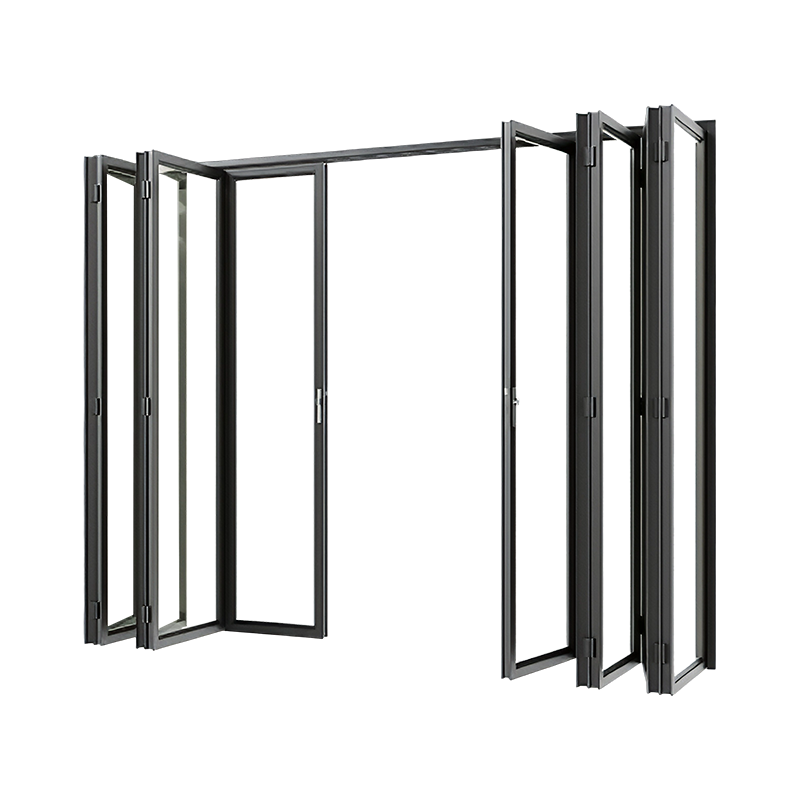
Folding aluminum door systems transform fixed walls into fully open configurations, achieving up to 90% clear opening width. This makes them invaluable for restaurant terraces, hotel ballrooms, and commercial showrooms where indoor-outdoor connectivity drives the customer experience. Even compact layouts benefit — small apartment balcony designs using folding aluminum systems can achieve a 180° panoramic view without structural modifications.
Tilt-and-turn aluminum doors combine ventilation and full-access opening in a single unit. The inward-tilting position provides controlled natural ventilation while maintaining weather resistance and security — a configuration increasingly specified in energy-efficient commercial buildings pursuing LEED or BREEAM certification.
Understanding the material trade-offs is essential for project managers and procurement teams making long-term investment decisions. The following comparison covers the performance dimensions most relevant to commercial building applications.
| Performance Category | Aluminum Alloy Doors | Wooden Doors | Steel Doors |
|---|---|---|---|
| Weight | Low | Medium | High |
| Corrosion Resistance | Excellent | Poor | Moderate |
| Thermal Insulation | High (with thermal break) | Medium | Low |
| Sound Insulation | High | Medium | Medium |
| Design Flexibility | Very High | High | Low |
| Maintenance Cost | Very Low | High | Medium |
| Typical Lifespan | 30–50 years | 10–20 years | 15–25 years |
 Safety, Sound Insulation, and Energy Efficiency in Commercial Settings
For residential, commercial, and public spaces, the performance trinity of safety, sound insulation, and energy efficiency is non-negotiable. Modern aluminum alloy doors are engineered to address all three simultaneously through layered technical design rather than compromises.
Safety in commercial aluminum door systems is achieved through multi-point locking hardware, reinforced corner jointing, and impact-resistant glazing integration. Many commercial configurations meet EN 1627 burglar resistance classifications, with frame rigidity tested against forced-entry attempts that wooden door frames regularly fail.
Sound insulation is delivered through the combination of dense aluminum profiles, compression sealing gaskets, and acoustic laminated glass. High-specification commercial aluminum door assemblies achieve sound reduction indices (Rw) of 42–48 dB — sufficient to meet acoustic requirements in hotels, hospitals, and open-plan office environments adjacent to urban noise sources.
Energy efficiency is built into the frame design via polyamide thermal break strips that interrupt the conductive aluminum path between interior and exterior surfaces. This dramatically reduces heat transfer, helping buildings maintain stable interior temperatures and reducing HVAC energy consumption — a critical factor as energy codes tighten globally and operating cost pressures on commercial building owners intensify.
Choosing the correct commercial aluminum doors configuration requires matching system capabilities to the specific functional, aesthetic, and regulatory requirements of the project. The following practical considerations guide the specification process:
Yicheng aluminum alloy doors and windows provide comprehensive consultation and full-specification support across all project types — from single-building residential installations to multi-building commercial campuses requiring coordinated portal, partition, and curtain wall solutions. The combination of humanized design philosophy, aviation-grade material selection, and a complete range of sliding, opening, folding, and tilting configurations ensures that every spatial challenge has a precise, engineered answer.


